
Bioregulators · Longevity
Epithalon
99.42% purity · Lot PZJF3M · tested Apr 25, 2026Tetrapeptide studied in telomerase and pineal research.
- Independently tested
- Lot-matched COA
- Lyophilized for stability
- Ships from the USA
Research use only. Not for human or veterinary use. Sold to qualified researchers aged 21+.
$185.00
1
Lot-matched documentation. Every order ships with the certificate for its lot. If a vial arrives damaged or doesn't match its paperwork, tell us within 72 hours and we'll replace it.
Latest lab results
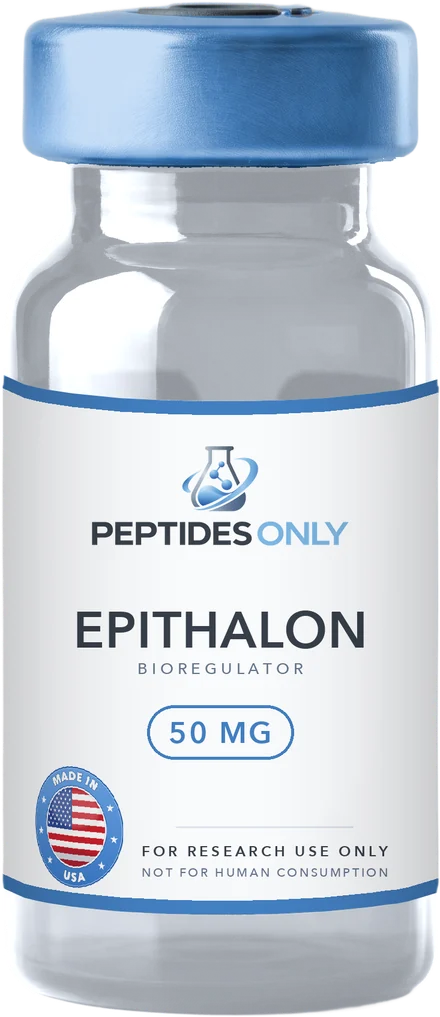
Third-party testedEpithalon 50 mg
- Purity (HPLC-UV)
- 99.42%
- Identity (LC-MS)
- Confirmed — Epitalon
- Lot
- PZJF3M
- Tested
- Apr 25, 2026
- Lab
- Freedom Diagnostics Testing
Your order ships with the certificate for its own lot.
About Epithalon
Tetrapeptide studied in telomerase and pineal research.
Supplied as
50 mg per vial, as a lyophilized powder in a sealed glass vial with a crimped cap. The lot number on the label matches the certificate of analysis in the COA library.
Storage and handling
Store lyophilized powder frozen (−20 °C) or refrigerated, sealed and away from light. Once reconstituted, keep refrigerated (2–8 °C).
Handle in a laboratory setting using appropriate protective equipment. Consult the certificate of analysis and safety data for lot-specific information.
Important research notice. This product is intended solely for in-vitro and laboratory research. It is not a drug, food, supplement or cosmetic, has not been evaluated by the FDA, and must not be used in humans or animals. Peptides Only does not provide usage or dosing information.
Research summary
Epithalon, also spelled Epitalon, is a synthetic tetrapeptide (Ala-Glu-Asp-Gly, or AEDG) designed from the amino-acid composition of epithalamin, a polypeptide extract of bovine pineal gland. It is best known for cell-culture studies reporting telomerase activation and telomere elongation, and for rodent and primate studies of aging markers and melatonin. Most of this research comes from one Russian group, and independent replication is limited.
- Also known as
- Epitalon · Epithalone · AEDG peptide · Ala-Glu-Asp-Gly
- Sequence
- Ala-Glu-Asp-Gly
What is Epithalon (Epitalon)?
Epithalon is the four-amino-acid peptide Ala-Glu-Asp-Gly. It was synthesized on the basis of the amino-acid composition of epithalamin, a bovine pineal gland extract, and appears in the literature as Epitalon, Epithalon and Epithalone1. Its developers, Vladimir Khavinson's group at the St. Petersburg Institute of Bioregulation and Gerontology, later reported detecting AEDG among the tetrapeptides of a pineal polypeptide complex by mass spectrometry2.
Over roughly 25 years the peptide has been studied in vitro, in vivo and in silico, with reported effects on melatonin synthesis, interleukin-2 mRNA and the activity of enzymes including acetylcholinesterase and telomerase; reviewers note it remains uncertain whether these are its only mechanisms1. A 2026 narrative review by US clinicians, which assesses synthetic Epitalon separately from the older epithalamin studies, concludes that it is biologically active but clinically unproven3.
Telomerase and telomere research
The finding most often linked to Epitalon is a 2003 study in which adding the peptide to telomerase-negative human fetal fibroblasts induced expression of the telomerase catalytic subunit, telomerase activity and telomere elongation4. A follow-up by the same group reported that treated fetal lung fibroblasts, whose telomeres had shortened with passaging, regained telomere length and went through ten more passages than controls while still dividing5.
For years these results came almost entirely from the same group. In 2025 a group at Brunel University London reported concentration-dependent telomere extension in normal human epithelial cells and fibroblasts through upregulation of hTERT and telomerase. In two breast cancer cell lines, telomeres also lengthened, but through the alternative lengthening of telomeres (ALT) pathway6. Because sustained telomere maintenance is also how cancer cells keep dividing, the cancer-cell result is a caution as much as a confirmation.
Animal and primate studies
In female SHR mice given Epitalon from three months of age until natural death, the peptide did not change food intake, body weight or mean life span. It did reduce chromosome aberrations in bone marrow cells and extended the life span of the last 10% of survivors by 13.3%; total tumor incidence was unchanged, while leukemia was less frequent7.
In old rhesus monkeys, Epitalon lowered basal glucose and insulin, raised night-time melatonin and changed the response to a glucose challenge, with no effect in young animals8. A perifusion study in a Paris laboratory, however, found that the tetrapeptide did not change melatonin secretion from isolated pineal glands of young or old rats, even after stimulation with isoproterenol9. One measured circulating hormone in living animals and the other glands in vitro, so the results are not strictly contradictory, but the melatonin question is not settled.
Other cell work includes a Chinese study in which Epitalon added to the culture medium of post-ovulatory mouse oocytes reduced reactive oxygen species, spindle defects and apoptosis during in vitro aging10, and a Russian-Italian study reporting higher expression of neuronal differentiation markers such as Nestin and GAP43 in human gingival mesenchymal stem cells11.
Limitations of the evidence
Most Epitalon studies come from Khavinson's institute and close collaborators in St. Petersburg. Replication by unrelated laboratories is limited to a handful of cell studies6,10. Human evidence consists of small physiological or biomarker studies and an older study in retinitis pigmentosa; no adequately powered randomized trial exists, and pharmacokinetic and long-term safety data are inadequate3.
- Telomere findings come from cultured cells, not from measurements in whole organisms4,6.
- The lifetime mouse study found no change in mean life span7.
- Melatonin findings differ between in vivo and in vitro models8,9.
- Epitalon is not FDA-approved; a 2026 review notes unresolved regulatory and product-quality questions after an FDA advisory review3.
Sourcing Epithalon for research
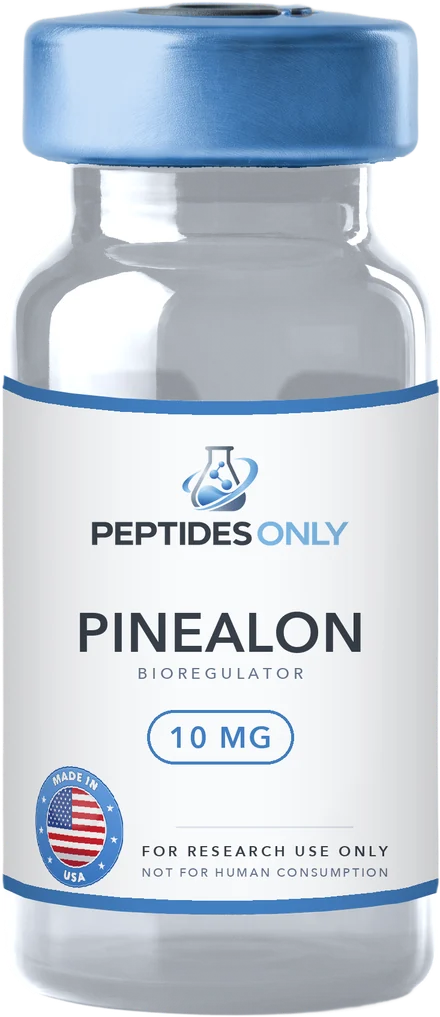
Epithalon sits in our bioregulators range alongside Pinealon. Every lot is independently tested and ships from the USA with a lot-matched certificate of analysis showing HPLC purity and mass-spec identity, published in our certificate library. For other compounds used in cellular-aging research, see NAD+ and MOTS-c.
Epithalon FAQ
Is Epitalon the same as Epithalon?
Yes. Epitalon, Epithalon and Epithalone are spellings of the same tetrapeptide, Ala-Glu-Asp-Gly (AEDG)1. Epithalamin is different: it is the pineal polypeptide extract the tetrapeptide was designed from3.
Does Epitalon activate telomerase?
Two groups have reported it in cultured human cells: Khavinson's group in fetal fibroblasts4 and an independent UK group in normal epithelial cells and fibroblasts6. The UK study also found telomere lengthening in cancer cell lines through the ALT pathway6. Whether this happens in whole organisms has not been established.
Is Epitalon approved by the FDA?
No. Epitalon is not an FDA-approved drug, and a 2026 review describes its regulatory and product-quality questions as unresolved3. Peptides Only sells Epithalon strictly as a research compound for laboratory use.
What is the difference between Epitalon and Pinealon?
Epitalon is a tetrapeptide (Ala-Glu-Asp-Gly) studied mainly for telomeres, melatonin and aging markers; Pinealon is a tripeptide (Glu-Asp-Arg) studied mainly in nerve-cell models. Both come from the same bioregulator program. Our Epitalon vs Pinealon article compares them side by side.
How is lyophilized Epithalon stored?
Like most lyophilized peptides, sealed vials are generally kept cold, dry and protected from light. See our guide to peptide storage and stability.
Further reading
References
- Araj SK, Brzezik J, et al. Overview of Epitalon-Highly Bioactive Pineal Tetrapeptide with Promising Properties. Int J Mol Sci. 2025;26(6):2691. PubMed 40141333
- Khavinson VK, Kopylov AT, et al. Identification of Peptide AEDG in the Polypeptide Complex of the Pineal Gland. Bull Exp Biol Med. 2017;164(1):41-43. PubMed 29124531
- Jain A, Gallacher DM, et al. Epitalon and Epithalamin: A Narrative Review of Mechanistic, Preclinical, and Clinical Evidence. Int J Mol Sci. 2026;27(19):8922. PubMed 42884164
- Khavinson VKh, Bondarev IE, et al. Epithalon peptide induces telomerase activity and telomere elongation in human somatic cells. Bull Exp Biol Med. 2003;135(6):590-2. PubMed 12937682
- Khavinson VKh, Bondarev IE, et al. Peptide promotes overcoming of the division limit in human somatic cell. Bull Exp Biol Med. 2004;137(5):503-6. PubMed 15455129
- Al-Dulaimi S, Thomas R, et al. Epitalon increases telomere length in human cell lines through telomerase upregulation or ALT activity. Biogerontology. 2025;26(5):178. PubMed 40908429
- Anisimov VN, Khavinson VKh, et al. Effect of Epitalon on biomarkers of aging, life span and spontaneous tumor incidence in female Swiss-derived SHR mice. Biogerontology. 2003;4(4):193-202. PubMed 14501183
- Goncharova ND, Vengerin AA, et al. Pineal peptides restore the age-related disturbances in hormonal functions of the pineal gland and the pancreas. Exp Gerontol. 2005;40(1-2):51-7. PubMed 15664732
- Djeridane Y, Khavinson VKh, et al. Effect of a synthetic pineal tetrapeptide (Ala-Glu-Asp-Gly) on melatonin secretion by the pineal gland of young and old rats. J Endocrinol Invest. 2003;26(3):211-5. PubMed 12809170
- Yue X, Liu SL, et al. Epitalon protects against post-ovulatory aging-related damage of mouse oocytes in vitro. Aging (Albany NY). 2022;14(7):3191-3202. PubMed 35413689
- Khavinson V, Diomede F, et al. AEDG Peptide (Epitalon) Stimulates Gene Expression and Protein Synthesis during Neurogenesis: Possible Epigenetic Mechanism. Molecules. 2020;25(3):609. PubMed 32019204
Research summary reviewed 2026-10-26 against the cited literature.
More Bioregulators
View all You might also need
Contact Peptides Only
Operated by DND Wellness LLC · 1309 Coffeen Ave, Suite 1200, Sheridan, WY 82801.
support@peptides-only.com · (508) 404-8124
Use the chat widget to ask a question. Informational and promotional text messages require separate, optional consent. Message frequency varies. Msg & data rates may apply. Reply STOP to unsubscribe or HELP for help. Consent is not a condition of purchase. 21+.
SMS consent & support · SMS terms & Terms of Service · Privacy Policy