
Peptides · Longevity
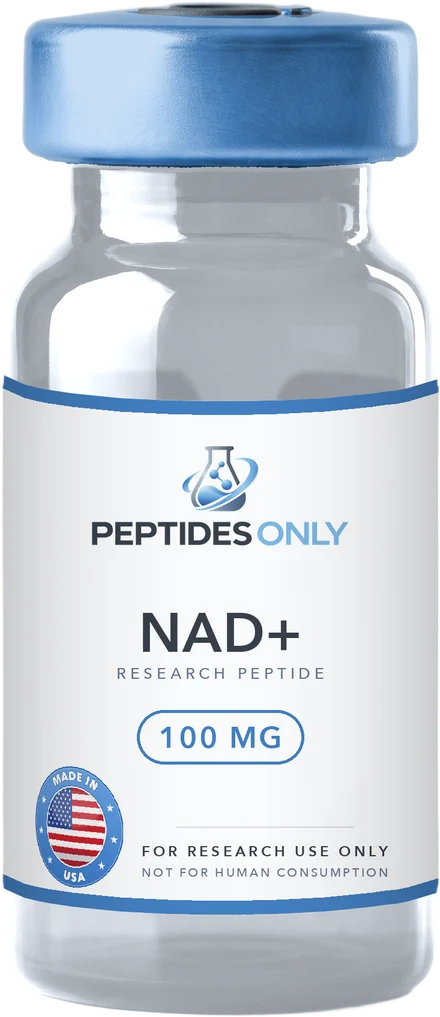
NAD+
99.85% purity · Lot J4Q90F · tested Apr 25, 2026CAS53-84-9FormulaC21H27N7O14P2MW663.43
Essential coenzyme for studies of cellular metabolism and ageing.
- Independently tested
- Lot-matched COA
- Lyophilized for stability
- Ships from the USA
Research use only. Not for human or veterinary use. Sold to qualified researchers aged 21+.
SizePO-NAD-100
$50.00
1
Lot-matched documentation. Every order ships with the certificate for its lot. If a vial arrives damaged or doesn't match its paperwork, tell us within 72 hours and we'll replace it.
Latest lab results
Third-party testedNAD+ 100 mg
- Purity (HPLC-UV)
- 99.85%
- Identity (LC-MS)
- Confirmed — NAD+
- Lot
- J4Q90F
- Tested
- Apr 25, 2026
- Lab
- Freedom Diagnostics Testing
Your order ships with the certificate for its own lot.
About NAD+
Essential coenzyme for studies of cellular metabolism and ageing.
Supplied as
100 mg per vial, as a lyophilized powder in a sealed glass vial with a crimped cap. The lot number on the label matches the certificate of analysis in the COA library.
Storage and handling
Store lyophilized powder frozen (−20 °C) or refrigerated, sealed and away from light. Once reconstituted, keep refrigerated (2–8 °C).
Handle in a laboratory setting using appropriate protective equipment. Consult the certificate of analysis and safety data for lot-specific information.
Important research notice. This product is intended solely for in-vitro and laboratory research. It is not a drug, food, supplement or cosmetic, has not been evaluated by the FDA, and must not be used in humans or animals. Peptides Only does not provide usage or dosing information.
Research summary
NAD+ (nicotinamide adenine dinucleotide) is a coenzyme found in every living cell, not a peptide: it carries electrons in oxidation-reduction reactions and is consumed as a co-substrate by enzymes such as the sirtuins and poly(ADP-ribose) polymerases1. Research interest has grown because tissue NAD+ levels decline with age in rodents and humans, a change studied in connection with mitochondrial function, DNA repair and metabolic regulation2. Peptides Only supplies NAD+ as a lyophilized research reagent for laboratory use.
- Also known as
- Nicotinamide adenine dinucleotide · NAD · β-NAD · Nadide · NAD+ coenzyme
What is NAD+?
Nicotinamide adenine dinucleotide is, as the name says, a dinucleotide: a nicotinamide nucleotide and an adenine nucleotide joined through their phosphate groups. It is a small organic coenzyme rather than a chain of amino acids. It is listed alongside research peptides because it is used in the same mitochondrial and aging research, but chemically it belongs to a different class.
NAD+ has two distinct jobs. In its oxidized form it accepts electrons in metabolic reactions and becomes NADH, which passes those electrons on, most importantly to the mitochondrial respiratory chain1,2. Separately, sirtuins, poly(ADP-ribose) polymerases (PARPs) and the NADase CD38 cleave NAD+ as a substrate, using it up rather than shuttling it between two states. Through these enzymes, NAD+ availability is connected to DNA repair, chromatin remodeling, cellular senescence and immune-cell function2.
How cells make, move and use NAD+
Cellular NAD+ reflects a balance between production and degradation3. Nicotinamide, a form of vitamin B3, is one of its precursors. The enzyme nicotinamide N-methyltransferase (NNMT) methylates nicotinamide using S-adenosylmethionine, which ties NAD+ metabolism to the cell's methylation balance4; that link is why NNMT inhibitors such as 5-Amino-1MQ are studied in the same context.
NAD+ is also compartmentalized. Mitochondria hold a pool that is distinct from the cytosol and nucleus, and in 2020 researchers identified SLC25A51 as a mammalian transporter that imports intact NAD+ into mitochondria. Cells lacking it had lower mitochondrial, but not whole-cell, NAD+ and impaired respiration5. A measurement of total NAD+ therefore does not necessarily describe the mitochondrial pool.
What the research on NAD+ and aging has examined
Much of the field rests on the observation that NAD+ falls with age. In human pelvic skin samples from donors ranging from newborns to 77 years old, tissue NAD+ correlated inversely with age, while PARP activity and markers of DNA damage rose; the associations were clearer in males than in females6.
Mechanistic work has proposed why. Camacho-Pereira and colleagues reported that expression and activity of the NAD-degrading enzyme CD38 increase with aging and that CD38 was required for the age-related NAD decline and mitochondrial dysfunction they observed, acting at least partly through the mitochondrial sirtuin SIRT37. Gomes and colleagues traced a loss of mitochondrially encoded respiratory-chain proteins in aging mice to falling nuclear NAD+, and reported that raising NAD+ in old mice restored mitochondrial function in a SIRT1-dependent manner8.
Reviews of the in vivo literature describe a consistent preclinical pattern, in which restoring NAD+ in old or diseased animals has been reported to promote measures of health and extend lifespan, while stressing that these findings come from animal models2,9.
NAD+ itself vs NAD+ precursors
Most of the strategies discussed for raising NAD+ in living organisms rely on precursors that cells convert into NAD+, rather than on NAD+ itself1. Precursors such as nicotinamide mononucleotide (NMN) and nicotinamide riboside (NR) are different molecules7,10, so findings from precursor studies cannot be assumed to apply to the coenzyme.
Data on NAD+ given directly to people are sparse. In a small pilot study that tracked plasma and urine during an intravenous NAD+ infusion, plasma NAD+ and its metabolites did not change for the first two hours, and the metabolite pattern was consistent with breakdown by NAD+ glycohydrolase and pyrophosphatase activity10. The study characterized how NAD+ is metabolized; it did not assess health outcomes.
Limitations of the evidence
- Causal findings linking NAD+ to aging come mainly from mice and other model organisms; human data are largely correlational or come from small pilot studies2,6,10.
- Reviews note that it is still unknown how best to restore NAD+ during human aging, whether doing so is safe, and whether it changes health in older people2.
- NAD+ is compartmentalized, so changes in plasma or whole-cell NAD+ may not reflect the mitochondrial pool5.
- Reported associations vary by tissue and sex; in human skin, the links between age, PARP activity and NAD+ were weaker in females6.
Working with NAD+ in the lab
NAD+ is supplied as a lyophilized powder. Once dissolved, nicotinamide cofactors degrade over time; a 2024 study of NAD+ and NADH in common laboratory buffers found that both the choice of buffer and a modest rise in temperature measurably affected long-term stability11. General guidance on handling lyophilized reagents is in our notes on peptide storage and stability.
Every Peptides Only lot ships from the USA with a lot-matched certificate of analysis from an independent lab, reporting HPLC purity and mass-spec identity. Certificates are published in the COA library.
NAD+ FAQ
Is NAD+ a peptide?
No. NAD+ is a dinucleotide coenzyme, not a chain of amino acids1. It is sold alongside peptides because it is used in the same mitochondrial research, often together with MOTS-c and SS-31, and all three are offered together in the NAD+ / MOTS-c / SS-31 Set.
What is the difference between NAD+ and NADH?
They are the oxidized and reduced forms of the same coenzyme. NAD+ accepts electrons in metabolic reactions and becomes NADH, which carries them on to other reactions, including the mitochondrial respiratory chain1,2.
Is NAD+ the same as NMN or NR?
No. Nicotinamide mononucleotide (NMN) and nicotinamide riboside (NR) are NAD+ precursors that cells convert into NAD+7,10. NAD+ is the end product, and results obtained with precursors should not be read across to NAD+ directly.
Does NAD+ decline with age?
Studies report that it does. Reviews describe a gradual decline in tissue NAD+ with age in rodents and humans2, and in human skin samples NAD+ correlated inversely with donor age6. Why it falls is still being worked out; increased consumption by CD38 is one leading explanation7.
Is NAD+ from Peptides Only for human use?
No. It is sold strictly as a research reagent for laboratory use. Identity and purity are documented on the lot-matched certificate of analysis; our guide on how to read a peptide COA explains each field.
References
- Verdin E. NAD⁺ in aging, metabolism, and neurodegeneration. Science. 2015;350(6265):1208-13. PubMed 26785480
- Covarrubias AJ, Perrone R, et al. NAD(+) metabolism and its roles in cellular processes during ageing. Nat Rev Mol Cell Biol. 2021;22(2):119-141. PubMed 33353981
- Yaku K, Okabe K, et al. NAD metabolism: Implications in aging and longevity. Ageing Res Rev. 2018;47:1-17. PubMed 29883761
- Roberti A, Fernández AF, et al. Nicotinamide N-methyltransferase: At the crossroads between cellular metabolism and epigenetic regulation. Mol Metab. 2021;45:101165. PubMed 33453420
- Luongo TS, Eller JM, et al. SLC25A51 is a mammalian mitochondrial NAD(+) transporter. Nature. 2020;588(7836):174-179. PubMed 32906142
- Massudi H, Grant R, et al. Age-associated changes in oxidative stress and NAD+ metabolism in human tissue. PLoS One. 2012;7(7):e42357. PubMed 22848760
- Camacho-Pereira J, Tarragó MG, et al. CD38 Dictates Age-Related NAD Decline and Mitochondrial Dysfunction through an SIRT3-Dependent Mechanism. Cell Metab. 2016;23(6):1127-1139. PubMed 27304511
- Gomes AP, Price NL, et al. Declining NAD(+) induces a pseudohypoxic state disrupting nuclear-mitochondrial communication during aging. Cell. 2013;155(7):1624-38. PubMed 24360282
- Rajman L, Chwalek K, et al. Therapeutic Potential of NAD-Boosting Molecules: The In Vivo Evidence. Cell Metab. 2018;27(3):529-547. PubMed 29514064
- Grant R, Berg J, et al. A Pilot Study Investigating Changes in the Human Plasma and Urine NAD+ Metabolome During a 6 Hour Intravenous Infusion of NAD. Front Aging Neurosci. 2019;11:257. PubMed 31572171
- Wolfe KD, Alahuhta M, et al. Long-Term Stability of Nicotinamide Cofactors in Common Aqueous Buffers: Implications for Cell-Free Biocatalysis. Molecules. 2024;29(22). PubMed 39598842
Research summary reviewed 2026-10-26 against the cited literature.
More Peptides
View all You might also need
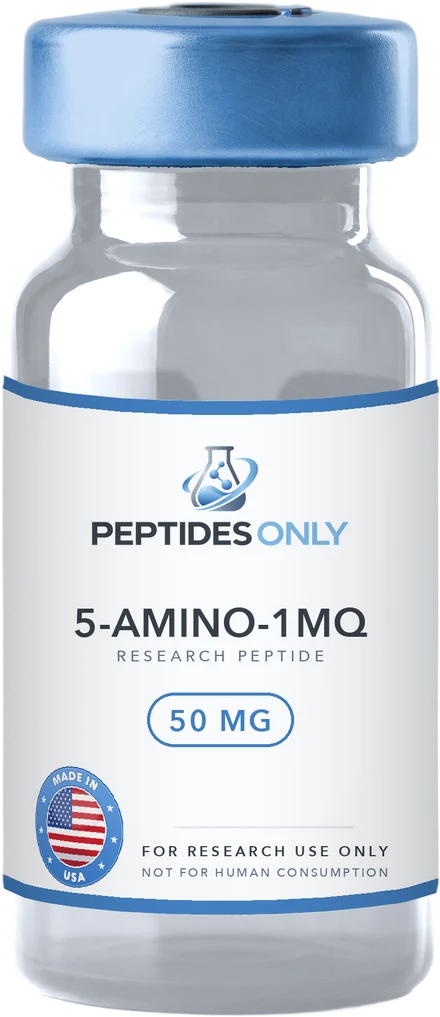
Lyophilized vial
5-Amino-1MQ
Small-molecule NNMT inhibitor studied in cellular energy research.
$115.00
Contact Peptides Only
Operated by DND Wellness LLC · 1309 Coffeen Ave, Suite 1200, Sheridan, WY 82801.
support@peptides-only.com · (508) 404-8124
Use the chat widget to ask a question. Informational and promotional text messages require separate, optional consent. Message frequency varies. Msg & data rates may apply. Reply STOP to unsubscribe or HELP for help. Consent is not a condition of purchase. 21+.
SMS consent & support · SMS terms & Terms of Service · Privacy Policy