
Peptides · GH Axis
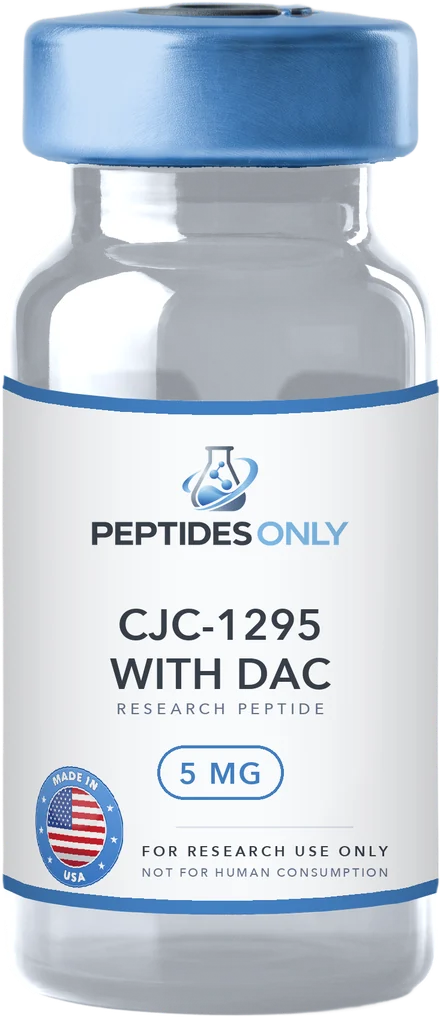
CJC-1295 (With DAC)
99.46% purity · Lot K68WPF · tested May 12, 2026GHRH analogue with a drug affinity complex, for extended half-life GH-axis research.
- Independently tested
- Lot-matched COA
- Lyophilized for stability
- Ships from the USA
Research use only. Not for human or veterinary use. Sold to qualified researchers aged 21+.
$120.00
1
Lot-matched documentation. Every order ships with the certificate for its lot. If a vial arrives damaged or doesn't match its paperwork, tell us within 72 hours and we'll replace it.
Latest lab results
Third-party testedCJC-1295 (With DAC) 5 mg
- Purity (HPLC-UV)
- 99.46%
- Identity (LC-MS)
- Confirmed — CJC-1295 with DAC
- Net content
- 5.28 mg (label 5 mg)
- Lot
- K68WPF
- Tested
- May 12, 2026
- Lab
- Freedom Diagnostics Testing
Your order ships with the certificate for its own lot. 1 earlier certificate for this size in the COA library.
About CJC-1295 (With DAC)
GHRH analogue with a drug affinity complex, for extended half-life GH-axis research.
Supplied as
5 mg per vial, as a lyophilized powder in a sealed glass vial with a crimped cap. The lot number on the label matches the certificate of analysis in the COA library.
Storage and handling
Store lyophilized powder frozen (−20 °C) or refrigerated, sealed and away from light. Once reconstituted, keep refrigerated (2–8 °C).
Handle in a laboratory setting using appropriate protective equipment. Consult the certificate of analysis and safety data for lot-specific information.
Important research notice. This product is intended solely for in-vitro and laboratory research. It is not a drug, food, supplement or cosmetic, has not been evaluated by the FDA, and must not be used in humans or animals. Peptides Only does not provide usage or dosing information.
Research summary
CJC-1295 with DAC is a long-acting synthetic analogue of growth hormone-releasing hormone (GHRH): the tetrasubstituted GHRH(1-29) peptide plus an extra lysine carrying a maleimidopropionyl group, the drug affinity complex, which bonds covalently to serum albumin1. It is the compound used in the published human studies of CJC-1295, which reported an estimated half-life of 5.8 to 8.1 days and sustained rises in growth hormone (GH) and IGF-I in healthy adults2. It is not an approved medicine and is sold for laboratory research only.
- Also known as
- CJC-1295 with DAC · CJC-1295 DAC · DAC:GRF
- Sequence
- Tyr-D-Ala-Asp-Ala-Ile-Phe-Thr-Gln-Ser-Tyr-Arg-Lys-Val-Leu-Ala-Gln-Leu-Ser-Ala-Arg-Lys-Leu-Leu-Gln-Asp-Ile-Leu-Ser-Arg-Lys(maleimidopropionyl)-NH2
What is CJC-1295 with DAC?
CJC-1295 was developed at ConjuChem, whose researchers built three maleimido derivatives of human GRF(1-29) designed to attach to albumin. All three albumin conjugates resisted dipeptidyl peptidase IV (DPP-IV) in vitro and released GH from cultured rat pituitary cells. The lead compound, CJC-1295, produced a fourfold larger GH area under the curve than GRF(1-29) over two hours in rats and was detectable in plasma beyond 72 hours1.
Its peptide portion is the tetrasubstituted 29-residue sequence (D-alanine 2, glutamine 8, alanine 15, leucine 27) that is also sold on its own as CJC-1295 without DAC. The drug affinity complex is the additional C-terminal lysine and its maleimide group1. The CJC-1295 + Ipamorelin blend uses the version without DAC.
How the drug affinity complex works
Native GHRH lasts minutes in circulation: intact GHRH(1-44) had a half-life of about 6.8 minutes after intravenous administration in people, largely because DPP-IV cleaves it at the N terminus3. The same limitation applies to sermorelin. The DAC approach sidesteps it by tying the peptide to albumin. The maleimide group reacts with the free thiol on cysteine 34 of serum albumin; in rats, a CJC-1295-immunoreactive band appeared at the albumin position within 15 minutes and was still present beyond 24 hours1.
Later papers describe the compound as binding selectively and covalently, in effect permanently, to endogenous albumin after administration4,5.
What the human studies found
Two randomized, placebo-controlled, double-blind trials in healthy adults aged 21 to 61, lasting 28 and 49 days, tested single and repeated administration at ascending amounts. After a single administration, mean plasma GH rose 2- to 10-fold for six days or more and mean IGF-I rose 1.5- to 3-fold for 9 to 11 days, with larger amounts producing larger increases. The estimated half-life was 5.8 to 8.1 days; with repeated administration, IGF-I stayed above baseline for up to 28 days, and no serious adverse reactions were reported2.
A follow-up study sampled blood every 20 minutes overnight in healthy men aged 20 to 40, before and one week after a single administration. GH pulses persisted with unchanged frequency and size, but trough GH rose about 7.5-fold, mean GH by 46% and IGF-I by 45%; the IGF-I rise did not correlate with any measure of pulsatile secretion5. A proteomic analysis of serum from 11 healthy young men, before and one week after administration, found shifts in apolipoprotein A1, transthyretin and albumin-fragment spots that the authors proposed as candidate biomarkers of GH and IGF-I action6.
Animal research
In mice lacking the GHRH gene, CJC-1295 given daily for five weeks from one week of age produced normal body weight and length, while the same amount given every 48 or 72 hours improved growth without fully normalizing it. Treated animals showed more pituitary GH mRNA and evidence of somatotroph proliferation4. Even for a long-acting analogue, the interval between administrations mattered in this model.
Regulatory status
CJC-1295 reached clinical trials in healthy adults2 but has not been approved as a medicine. It is classed as a prohibited substance under section S2 of the World Anti-Doping Agency list7, and doping-control laboratories have developed methods that detect both CJC-1295 and CJC-1295 with DAC8.
Limitations of the evidence
- The human evidence is a handful of short studies in healthy volunteers2,5,6; there are no long-term safety data and no controlled trials in any patient population.
- The pulsatility finding comes from a single overnight sampling study in young men5.
- The name is used loosely: a preparation sold as CJC-1295 and analyzed by a doping-control laboratory contained the 29-residue peptide without the DAC lysine7, and a 2026 clinical review highlighted uncertainty about product composition in unregulated supply chains9.
- The two versions differ in mass by roughly 279 daltons, so mass spectrometry tells them apart. Every Peptides Only lot ships with a lot-matched certificate of analysis (HPLC purity and mass-spec identity) from an independent lab, published at our COA library.
CJC-1295 (With DAC) FAQ
What is the difference between CJC-1295 with DAC and without DAC?
Both share the same tetrasubstituted GHRH(1-29) backbone; only the DAC version carries the albumin-binding lysine, which gives it a half-life measured in days in people2. We compare them in detail in CJC-1295 with DAC vs without DAC.
What is the half-life of CJC-1295 with DAC?
In healthy adults the estimated half-life was 5.8 to 8.1 days2; a later paper summarized it as about eight days5.
Does CJC-1295 with DAC stop natural GH pulses?
In the one study that measured it, no. Pulse frequency and size were unchanged one week after a single administration, while trough and mean GH rose5.
Is CJC-1295 FDA-approved?
No. It was studied in early clinical trials2 but has never been approved, and it is prohibited in sport7. Peptides Only supplies it for laboratory research only.
Is DAC:GRF the same as CJC-1295 with DAC?
Yes. DAC:GRF is shorthand for a GRF(1-29) analogue carrying the drug affinity complex, which is CJC-1295 as originally described1. The version without the complex is sold as CJC-1295 without DAC or Mod GRF (1-29).
Further reading
References
- Jetté L, Léger R, et al. Human growth hormone-releasing factor (hGRF)1-29-albumin bioconjugates activate the GRF receptor on the anterior pituitary in rats: identification of CJC-1295 as a long-lasting GRF analog. Endocrinology. 2005;146(7):3052-8. PubMed 15817669
- Teichman SL, Neale A, et al. Prolonged stimulation of growth hormone (GH) and insulin-like growth factor I secretion by CJC-1295, a long-acting analog of GH-releasing hormone, in healthy adults. J Clin Endocrinol Metab. 2006;91(3):799-805. PubMed 16352683
- Frohman LA, Downs TR, et al. Rapid enzymatic degradation of growth hormone-releasing hormone by plasma in vitro and in vivo to a biologically inactive product cleaved at the NH2 terminus. J Clin Invest. 1986;78(4):906-13. PubMed 3093533
- Alba M, Fintini D, et al. Once-daily administration of CJC-1295, a long-acting growth hormone-releasing hormone (GHRH) analog, normalizes growth in the GHRH knockout mouse. Am J Physiol Endocrinol Metab. 2006;291(6):E1290-4. PubMed 16822960
- Ionescu M, Frohman LA. Pulsatile secretion of growth hormone (GH) persists during continuous stimulation by CJC-1295, a long-acting GH-releasing hormone analog. J Clin Endocrinol Metab. 2006;91(12):4792-7. PubMed 17018654
- Sackmann-Sala L, Ding J, et al. Activation of the GH/IGF-1 axis by CJC-1295, a long-acting GHRH analog, results in serum protein profile changes in normal adult subjects. Growth Horm IGF Res. 2009;19(6):471-7. PubMed 19386527
- Henninge J, Pepaj M, et al. Identification of CJC-1295, a growth-hormone-releasing peptide, in an unknown pharmaceutical preparation. Drug Test Anal. 2010;2(11-12):647-50. PubMed 21204297
- Memdouh S, Gavrilović I, et al. Advances in the detection of growth hormone releasing hormone synthetic analogs. Drug Test Anal. 2021;13(11-12):1871-1887. PubMed 34665524
- Dominikowski A, Rękoś Z, et al. The emerging landscape of performance-enhancing peptides modulating GH-IGF1 axis: bridging the gap between clinical evidence and patient self-administration. Front Endocrinol (Lausanne). 2026;17:1822475. PubMed 42395176
Research summary reviewed 2026-10-26 against the cited literature.
More Peptides
View all You might also need
Contact Peptides Only
Operated by DND Wellness LLC · 1309 Coffeen Ave, Suite 1200, Sheridan, WY 82801.
support@peptides-only.com · (508) 404-8124
Use the chat widget to ask a question. Informational and promotional text messages require separate, optional consent. Message frequency varies. Msg & data rates may apply. Reply STOP to unsubscribe or HELP for help. Consent is not a condition of purchase. 21+.
SMS consent & support · SMS terms & Terms of Service · Privacy Policy