
RESEARCH HORMONE · Hormonal
HCG
Third-party tested · COA with every order
Glycoprotein hormone used in LH-receptor and reproductive endocrinology research.
- Independently tested
- Lot-matched COA
- Lyophilized for stability
- Ships from the USA
Research use only. Not for human or veterinary use. Sold to qualified researchers aged 21+.
$125.00
1
Lot-matched documentation. Every order ships with the certificate for its lot. If a vial arrives damaged or doesn't match its paperwork, tell us within 72 hours and we'll replace it.
Latest lab results
Third-party testedThe certificate for the current lot is being uploaded. Every order ships with the COA for its lot, or request it now.
About HCG
Glycoprotein hormone used in LH-receptor and reproductive endocrinology research.
Supplied as
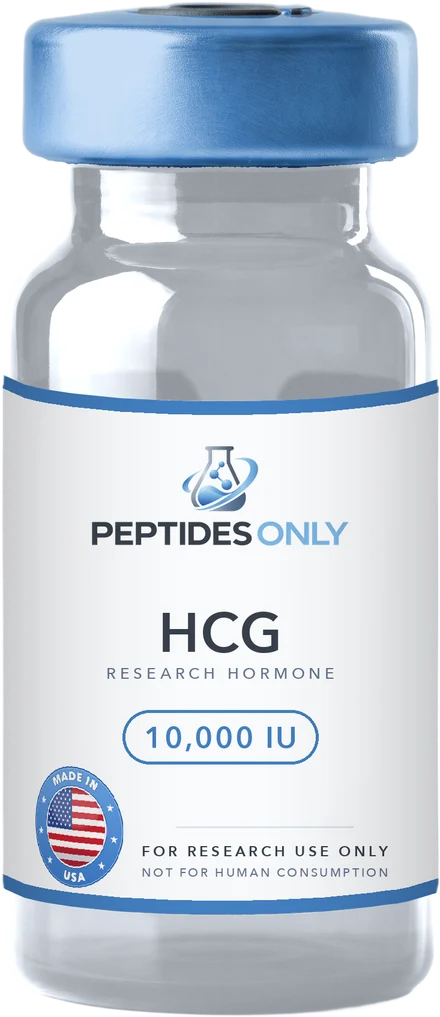
10,000 IU per vial, as a lyophilized powder in a sealed glass vial with a crimped cap. The lot number on the label matches the certificate of analysis in the COA library.
Storage and handling
Store lyophilized powder frozen (−20 °C) or refrigerated, sealed and away from light. Once reconstituted, keep refrigerated (2–8 °C).
Handle in a laboratory setting using appropriate protective equipment. Consult the certificate of analysis and safety data for lot-specific information.
Important research notice. This product is intended solely for in-vitro and laboratory research. It is not a drug, food, supplement or cosmetic, has not been evaluated by the FDA, and must not be used in humans or animals. Peptides Only does not provide usage or dosing information.
Research summary
Human chorionic gonadotropin (hCG) is a glycoprotein hormone made mainly by the placenta, built from an alpha subunit shared with LH, FSH and TSH and a hormone-specific beta subunit. It acts at the same receptor as luteinizing hormone, the LH/CG receptor, which makes it a standard tool in reproductive endocrinology and LH-receptor research. The material sold here is a research reagent, separate from FDA-approved prescription hCG medicines.
- Also known as
- human chorionic gonadotropin · chorionic gonadotropin · choriogonadotropin
What is hCG?
hCG is the first hormonal message from the placenta to the mother: it is detectable in maternal blood shortly after implantation and behaves like an agonist of LH, stimulating progesterone secretion by the corpus luteum1. It is a heterodimer. The alpha subunit is identical to that of the pituitary hormones LH, FSH and TSH, while the beta subunit is distinct and confers receptor specificity; hCG-beta carries two N-linked and four O-linked glycosylation sites1.
The crystal structure, solved in 1994, showed that each subunit folds around a cystine knot and that a segment of the beta subunit wraps around the alpha subunit like a seat belt, a feature needed for both heterodimer assembly and receptor binding2. hCG-beta also has a carboxyl-terminal peptide extension that the other beta subunits lack; its O-linked sugars play little part in receptor binding but are critical for in vivo half-life3.
How hCG acts at the LH/CG receptor
hCG and LH share one receptor, LHCGR, cloned from rat ovary in 1989: a G protein-coupled receptor with a large leucine-rich extracellular domain that raises cAMP when bound by hCG4. Because the two hormones share that receptor, they were long treated as equivalent, but they differ in structure, half-life and signaling5.
In cells engineered to express LHCGR, hCG was about five-fold more potent than LH at raising cAMP, whereas LH activated ERK1/2 and AKT more strongly in human granulosa cells6. Real-time BRET and FRET studies describe the two as natural biased agonists of the same receptor7. In mouse Leydig cells, by contrast, hCG and LH differed in early signaling but produced equal testosterone synthesis8, so results depend on the cell model.
What hCG research covers
- Receptor pharmacology: LH versus hCG signaling, biased agonism and steroidogenesis in granulosa and Leydig cell models6,7,8.
- Placental biology: hCG glycoforms differ by source and stage of pregnancy, and hyperglycosylated hCG is linked to trophoblast invasion1,9.
- Tumor markers: the free hCG beta subunit is produced by a range of non-trophoblastic malignancies, where its detection is generally considered a poor prognostic sign9.
- Bioassay standards: pharmacopoeial gonadotropin assays rely on rodent Leydig-cell responses, so ligand differences matter for standardization8.
Approved medicines vs research material
FDA-approved hCG products exist, including urine-derived chorionic gonadotropin and a recombinant form, choriogonadotropin alfa; they are prescription-only and approved for specific reproductive-endocrine indications. FDA states that there are no FDA-approved hCG products for weight loss, and the prescription labeling says hCG has not been demonstrated to be effective adjunctive therapy for obesity. A 1995 criteria-based meta-analysis of 24 trials reached the same conclusion, finding no scientific evidence that hCG produces weight loss or fat redistribution10.
Research-grade hCG, including the product sold here, is not any of those medicines. It is supplied for in vitro and animal research only, and Peptides Only provides no information on human use.
Limitations and what to check
hCG is a family of glycoforms rather than a single molecule, and biological activity varies with source and glycosylation1,9; LH and hCG are also not interchangeable at the receptor level5. Researchers should record the source of any hCG they use and confirm identity by lot. Every Peptides Only lot ships with a lot-matched certificate of analysis from an independent lab, published in the COA library; see our testing standard and how to read a peptide COA.
HCG FAQ
Is hCG approved by the FDA?
Yes, as prescription medicines approved for specific reproductive-endocrine indications. Those approvals do not cover research-grade material, and FDA states that there are no FDA-approved hCG products for weight loss.
Is hCG the same as LH?
No. They share the alpha subunit and the LH/CG receptor, but their beta subunits differ, LH has a half-life of about 90 minutes while hCG's is measured in hours, and the two trigger different signaling patterns in human granulosa cells5,6.
What does the research say about hCG and weight loss?
A 1995 meta-analysis of controlled and uncontrolled trials found no scientific evidence that hCG causes weight loss or fat redistribution, or reduces hunger10, and FDA states that no hCG products are approved for weight loss. Peptides Only does not sell hCG for that or any other human use.
Why does hCG last longer in circulation than LH?
The hCG beta subunit carries a carboxyl-terminal peptide with O-linked oligosaccharides that is critical for its in vivo half-life3.
Is hCG a peptide?
It is a heterodimeric glycoprotein hormone: two glycosylated protein subunits held together noncovalently3 and stabilized by a seat-belt segment of the beta subunit2. That makes it far larger and more complex than short synthetic research peptides. General handling guidance is in peptide storage and stability.
References
- Fournier T, Guibourdenche J, et al. Review: hCGs: different sources of production, different glycoforms and functions. Placenta. 2015;36 Suppl 1:S60-5. PubMed 25707740
- Lapthorn AJ, Harris DC, et al. Crystal structure of human chorionic gonadotropin. Nature. 1994;369(6480):455-61. PubMed 8202136
- Fares F. The role of O-linked and N-linked oligosaccharides on the structure-function of glycoprotein hormones: development of agonists and antagonists. Biochim Biophys Acta. 2006;1760(4):560-7. PubMed 16527410
- McFarland KC, Sprengel R, et al. Lutropin-choriogonadotropin receptor: an unusual member of the G protein-coupled receptor family. Science. 1989;245(4917):494-9. PubMed 2502842
- Casarini L, Santi D, et al. Two Hormones for One Receptor: Evolution, Biochemistry, Actions, and Pathophysiology of LH and hCG. Endocr Rev. 2018;39(5):549-592. PubMed 29905829
- Casarini L, Lispi M, et al. LH and hCG action on the same receptor results in quantitatively and qualitatively different intracellular signalling. PLoS One. 2012;7(10):e46682. PubMed 23071612
- Riccetti L, Yvinec R, et al. Human Luteinizing Hormone and Chorionic Gonadotropin Display Biased Agonism at the LH and LH/CG Receptors. Sci Rep. 2017;7(1):940. PubMed 28424471
- Riccetti L, De Pascali F, et al. Human LH and hCG stimulate differently the early signalling pathways but result in equal testosterone synthesis in mouse Leydig cells in vitro. Reprod Biol Endocrinol. 2017;15(1):2. PubMed 28056997
- Cole LA. Biological functions of hCG and hCG-related molecules. Reprod Biol Endocrinol. 2010;8:102. PubMed 20735820
- Lijesen GK, Theeuwen I, et al. The effect of human chorionic gonadotropin (HCG) in the treatment of obesity by means of the Simeons therapy: a criteria-based meta-analysis. Br J Clin Pharmacol. 1995;40(3):237-43. PubMed 8527285
Research summary reviewed 2026-10-26 against the cited literature.
More Peptides
View all You might also need
Contact Peptides Only
Operated by DND Wellness LLC · 1309 Coffeen Ave, Suite 1200, Sheridan, WY 82801.
support@peptides-only.com · (508) 404-8124
Use the chat widget to ask a question. Informational and promotional text messages require separate, optional consent. Message frequency varies. Msg & data rates may apply. Reply STOP to unsubscribe or HELP for help. Consent is not a condition of purchase. 21+.
SMS consent & support · SMS terms & Terms of Service · Privacy Policy